
Feldenkrais Method®️ For Parkinsons: Learn to Move with More Ease
Written by Stacy Barrows, PT, DPT, GCFP, NCPT
Introduction
The Feldenkrais Method, developed by a physicist-neuroscientist, is a body of work that focuses on what the body can do while learning new possibilities to discover easier movement. Reducing effort and heightening awareness enables one to reduce internal resistance. It’s like finding a way to turn off the emergency brake doing daily tasks.
Components of the Feldenkrais Method
There are two approaches, that are like two sides of the same coin.
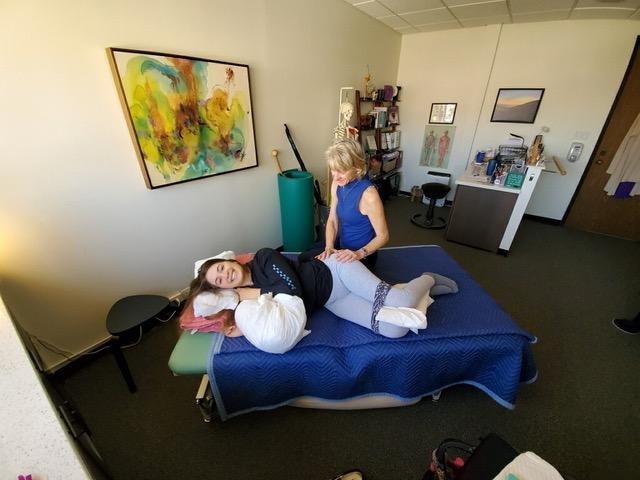
Functional Integration®️: Through the touch application, the teacher assists one to feel areas that tend to be hidden to discover a new refined sense of movement.
Awareness Through Movement®️: The class version is like crossword puzzles for the body. This application in which you move slowly to find least resistance.
Benefits of the Feldenkrais Method:
People often feel empowered by this method because they learn for themselves how to move better, versus being corrected by a teacher. Because this method is about setting up learning conditions by slowing down to move through ease, and paying close attention, it allows neuroplasticity to occur.
Where does this fit in with someone with the diagnosis of Parkinson’s Disease (PD)? For all of us, we lose the ability to sense or how to interpret our body’s signals as we change through age, injury and disease. Our body maps need to be updated to allow us to move with the best possible choices, consciously and more importantly unconsciously. Dr. Feldenkrais devised a way to engage our learning process to update these maps, like we did as developing children.
What Does the Research Say?
A study by Teixeira-Machado and colleagues (2015) concluded that, “The findings in the current study indicate that it is likely that the practice of a program based on the Feldenkrais method can contribute greatly to the quality of life of patients with PD, suggesting the importance of interventions that promote wellness for this population.”
Getting Started
- Set aside time you will not be disturbed.
- Be kind to yourself, learning something new is meant to make mistakes, so try approaching this kind of movement education with an open body and mind.
- Learn from a certified instructor which can be found on the Feldenkrais.com website; preferably in person at first.
- Wear loose, comfortable clothing and bring a sweater if you find you cool down easily (often these classes lower your body temperature because you learn to work less to move better).
- Stay in the ‘no pain more gain’ attitude, meaning stay away from pain and look for the feel good sensations.
- Because the intention for the movements are for exploration, you do the movements with directed attention to the quality.
- Take rests, they are built into the lessons, and rest more if you need to.
Class Selection Tips
How to choose the right program:
- Look for instructors experienced with Parkinson’s.
- Ask about small class sizes for more personal attention.
- Talk with the instructor to see if the class meets your intentional goals, and see if the pace of the group is a good match for you. In other words, can you do the classes in a chair, or are they modifiable?
Safety Precautions for Parkinson’s
Before starting the Feldenkrais Method, particularly for individuals with balance concerns, safety is essential:
- Get medical clearance from a healthcare provider before engaging in an exercise program.
- Practice near a stable surface or wall for support.
- Be aware that the intention of the class is not to keep up but to attend to your needs, so frequent rests are built into the classes for better learning.
- Use supports and chairs for mat classes, if needed.
Helpful Resources
- What is Feldenkrais?, Feldenkrais Education
- Feldenkrais Parkinsons Posture and Arms, NW Parkinson’s Foundation
- The Feldenkrais Method, Parkinson’s Resource Organization
- A Feldenkrais Class by Baby Liv, Irene Gutteridge
Final Thoughts
The Feldenkrais Method supports learning through improved body awareness of your body, called somatic (soma = body) education. By enhancing this form of awareness, you may uncover new alternative movements to accomplish activities of daily living. Students of this work often feel empowered by a sense of taking control to make things happen.
References
- Barrows S. Mind body Movements - Feldenkrais Method: In: The Lifestyle Medicine Toolbox. London: Jessica Kingsley Publishers, 2024.
- Barrows S. Somatic Education: Feldenkrais and Pilates. In: The Feldenkrais Method: Learning Through Movement, Handspring Publishers, 2021.
- Barrows S. Smartroller: Guide to Optimal Movement 2nd ed. OPTP publisher 2018.
- Berland R, Marques-Sule E, Marín-Mateo JL, Moreno-Segura N, López-Ridaura A, Sentandreu-Mañó T. Effects of the Feldenkrais Method as a physiotherapy tool: a systematic review and meta-analysis of randomized controlled trials. Int J Environ Res Public Health. 2022;19(21):13734. https://pubmed.ncbi.nlm.nih.gov/36360614/
- Hillier S, Worley A. The effectiveness of the Feldenkrais method: a systematic review of the evidence. Evid Based Complement Alternat Med. 2015;2015:752160. https://pubmed.ncbi.nlm.nih.gov/25949266/
- Shafarman S. Awareness Heals: The Feldenkrais Method for Dynamic Health. Da Capo Press, 1997.
- Teixeira-Machado L, Araújo FM, Cunha FA, Menezes M, Menezes T, Melo DeSantana J. Feldenkrais Method-based exercise improves quality of life in individuals with Parkinson's disease: a controlled, randomized clinical trial. Altern Ther Health Med. 2015;21(1):8-14. https://pubmed.ncbi.nlm.nih.gov/25599428/
Written by Stacy Barrows, PT, DPT, GCFP, NCPT
Donate Today,
Change Lives Forever
PCLA is powered by generous contributions from people like you.
Please consider donating today so we can continue to provide critical support to those impacted by Parkinson’s.
